

 English
 中文简体
 русский
 Español
 عربى





Huadong: Established in 1986
Inquiry Us Now
News&Inspiration
Contact Us
What Is a Thermocouple Used For? Types, Plugs and Heads Guide
Content
A thermocouple is used to measure temperature in places where ordinary sensors fail: furnaces, engines, kilns, boilers, gas appliances, and industrial process lines. It is the most widely used industrial temperature sensor because it is rugged, inexpensive, fast to respond, and works across a range of roughly -270°C to 1,800°C depending on type. It consists of two dissimilar metal wires joined at one end, and it produces a small voltage that changes predictably with temperature.
Two accessories matter just as much as the sensor itself. A thermocouple plug (connector) lets you attach and swap probes without breaking the signal, and a thermocouple head protects the wiring connections at the top of the probe. The sections below explain how each part works, where thermocouples are used, and how to choose the right combination.
What a Thermocouple Does and How It Works
A thermocouple works on the Seebeck effect. When two different metals are joined at a measuring junction and the other ends are held at a known reference temperature, a voltage appears that depends on the temperature difference between the two points. That voltage is tiny, typically around 40 microvolts per °C for a Type K thermocouple, so a controller or meter must amplify it and compensate for the reference (cold junction) temperature.
Why engineers choose thermocouples
- Wide temperature range, far beyond most RTDs and thermistors
- Fast response, with exposed-junction probes reacting in under one second
- Self-powered signal, so no excitation current is required
- Low cost, often under $10 for a basic probe
- Durable construction that tolerates vibration and harsh environments
Main limitation
Accuracy is lower than that of an RTD. Standard-grade Type K probes are typically accurate to ±2.2°C or ±0.75%, whichever is greater, while a Class A platinum RTD can reach about ±0.15°C at 0°C.
What a Thermocouple Is Used For in Real Applications
Thermocouples appear in nearly every industry where heat must be monitored or controlled. The table below shows common uses and the types usually chosen.
| Application | What is measured | Common type |
|---|---|---|
| Gas water heaters and furnaces | Pilot flame presence | Type K or special alloy |
| Industrial ovens and kilns | Chamber temperature up to 1,200°C | Type K |
| Steel and glass production | Molten metal or glass above 1,400°C | Type S, R, or B |
| Food processing | Cooking and pasteurization | Type T or K |
| Automotive and aerospace | Exhaust gas and turbine temperature | Type K |
| Cryogenics and laboratories | Very low temperatures | Type T |
In domestic gas appliances, the thermocouple generates a small millivolt signal from the pilot flame that holds the safety valve open. If the flame goes out, the voltage drops and the gas shuts off, which makes it a simple and reliable safety device.
Choosing the Right Thermocouple Type
For most general-purpose work, Type K is the default choice. It is affordable, available everywhere, and covers about -200°C to 1,250°C. Other types make sense when you need higher temperatures, better accuracy, or resistance to specific atmospheres.
| Type | Approx. range | Best for |
|---|---|---|
| K | -200°C to 1,250°C | General industrial use |
| J | -40°C to 750°C | Older equipment, reducing atmospheres |
| T | -200°C to 350°C | Food, cryogenics, labs |
| E | -200°C to 900°C | High sensitivity needs |
| N | -270°C to 1,300°C | Better long-term stability than K |
| S / R | 0°C to 1,600°C | High-temperature, high-accuracy work |
| B | 600°C to 1,700°C | Very hot furnaces |
Ranges are approximate and depend on wire gauge, sheath material, and manufacturer. Always confirm limits on the datasheet before purchasing.
Thermocouple Plug: Connector Types and Selection
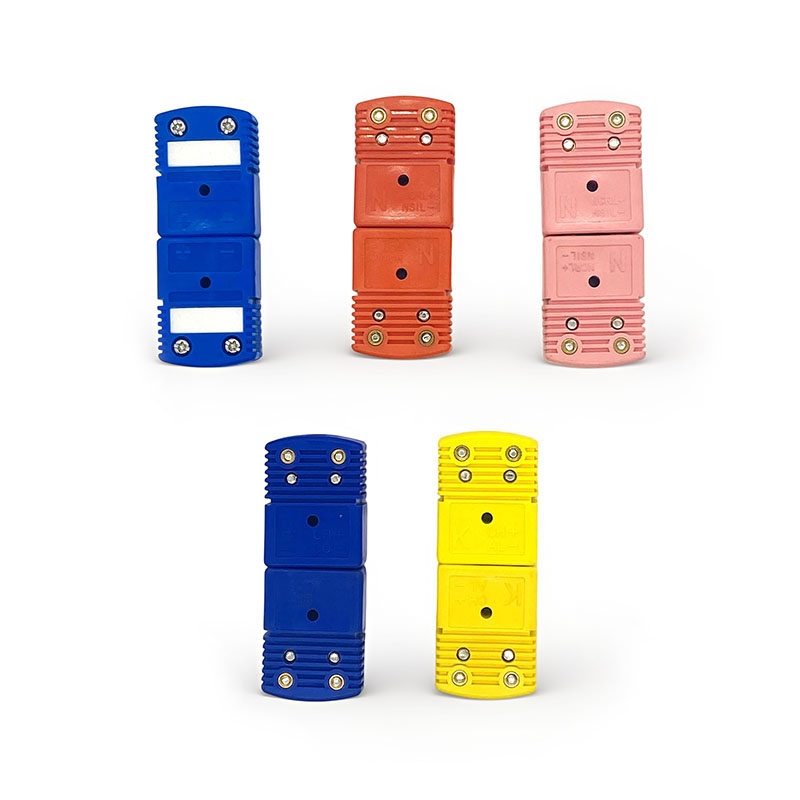
A thermocouple plug connects the probe to extension wire, a meter, or a controller. The plug must match the thermocouple type, because its internal contacts are made from the same alloys as the wire. Using a standard copper connector introduces a second junction and creates measurement errors that can reach several degrees.
Standard versus miniature plugs
- Standard plugs have flat blades about 7.9 mm apart and suit panel and bench equipment
- Miniature plugs have blades about 4.8 mm apart and suit handheld meters and tight spaces
- Screw-terminal and bare-wire connectors suit permanent installations
Color coding to prevent mistakes
Under the ANSI standard, Type K plugs are yellow, Type J are black, Type T are blue, and Type E are purple. IEC color codes differ, for example Type K is green under IEC 60584, so check which standard your equipment follows. Match polarity too: the red lead is negative in ANSI-coded wire, and reversing it produces a falling reading as temperature rises.
Plug selection checklist
- Confirm the thermocouple type and color standard
- Choose standard or miniature size to fit your instrument
- Check the maximum temperature rating of the plug body, often 200°C to 220°C for plastic housings
- Tighten the wire terminals firmly so contact resistance stays low
Thermocouple Head: Protecting the Connection Point
A thermocouple head is the enclosure mounted at the top of a probe or protection tube. It houses the terminal block where the thermocouple wires connect to the extension cable. Its job is to keep moisture, dust, and heat away from the terminals, which are the weakest point of most installations.
Common head materials and ratings
| Material | Strength | Typical use |
|---|---|---|
| Aluminum | Lightweight, good heat dissipation | General industry |
| Cast iron | Heavy duty, impact resistant | Furnaces, foundries |
| Stainless steel | Corrosion resistant | Chemical, marine, food plants |
| Polypropylene or plastic | Low cost, non-conductive | Low-temperature or wet areas |
Features to check
- Ingress protection rating, with IP65 or higher recommended for outdoor or washdown areas
- Gasket quality and a screw-on or hinged lid that seals fully
- Cable entry thread size, such as M20 or NPT 1/2 inch, to match your conduit or gland
- Hazardous-area certification such as ATEX or IECEx when flammable gases are present
- Optional transmitter space, since many heads can hold a 4-20 mA temperature transmitter
Common Problems and How to Avoid Them
Most thermocouple errors come from installation and wiring rather than the sensor. Using the wrong extension wire or a mismatched connector is the most frequent cause of inaccurate readings.
Typical faults and fixes
- Drifting readings: wire aging at high temperature, so replace the probe or move to a more stable type such as N
- Reading too low: poor immersion depth, so insert the probe at least 10 times its sheath diameter
- Noisy signal: electrical interference, so use shielded cable and keep it away from power lines
- Open circuit or no reading: broken wire, loose terminal, or moisture in the head
Quick testing method
Check continuity with a multimeter, then compare the probe against a known reference in an ice bath (0°C) and boiling water (about 100°C at sea level). A deviation larger than the rated tolerance means the probe should be replaced. For gas pilot thermocouples, a healthy unit typically produces about 25 to 30 millivolts when heated by the flame.
Final Recommendation
Thermocouples are used wherever fast, rugged, wide-range temperature sensing is needed, from household gas appliances to steel furnaces. Start with a Type K probe unless your temperature range or accuracy needs clearly call for another type, then match the plug to the same type and color standard, and choose a thermocouple head with an IP rating suited to the environment. Getting these three components aligned prevents most measurement errors and extends the life of the installation.
PREV:Armored Heating Cables Meet Thermocouple Compensation Wires: Building a Heating Loop That Reads True
NEXT:How a hot runner heater works?
NEXT:How a hot runner heater works?
Recommended Products

Our factory mainly produces various series and specifications of temperature sensors, armored
thermocouple cables, hot runner mold electric heaters, armored heating cables, thermocouple compensation
wires (copper-coated), and special equipment for the temperature instrument industry.
-
 +86-0577-62312532
-
 ben@china-h.com
sales03@china-h.com -
 Hongqiao Shifan Industrial Zone, Yueqing City, Zhejiang, China
Let's Work Together
Copyright © Yueqing Huadong Instrument And Meter Factory
All Rights Reserved.
 Custom Armored Thermocouple Cables Manufacturers